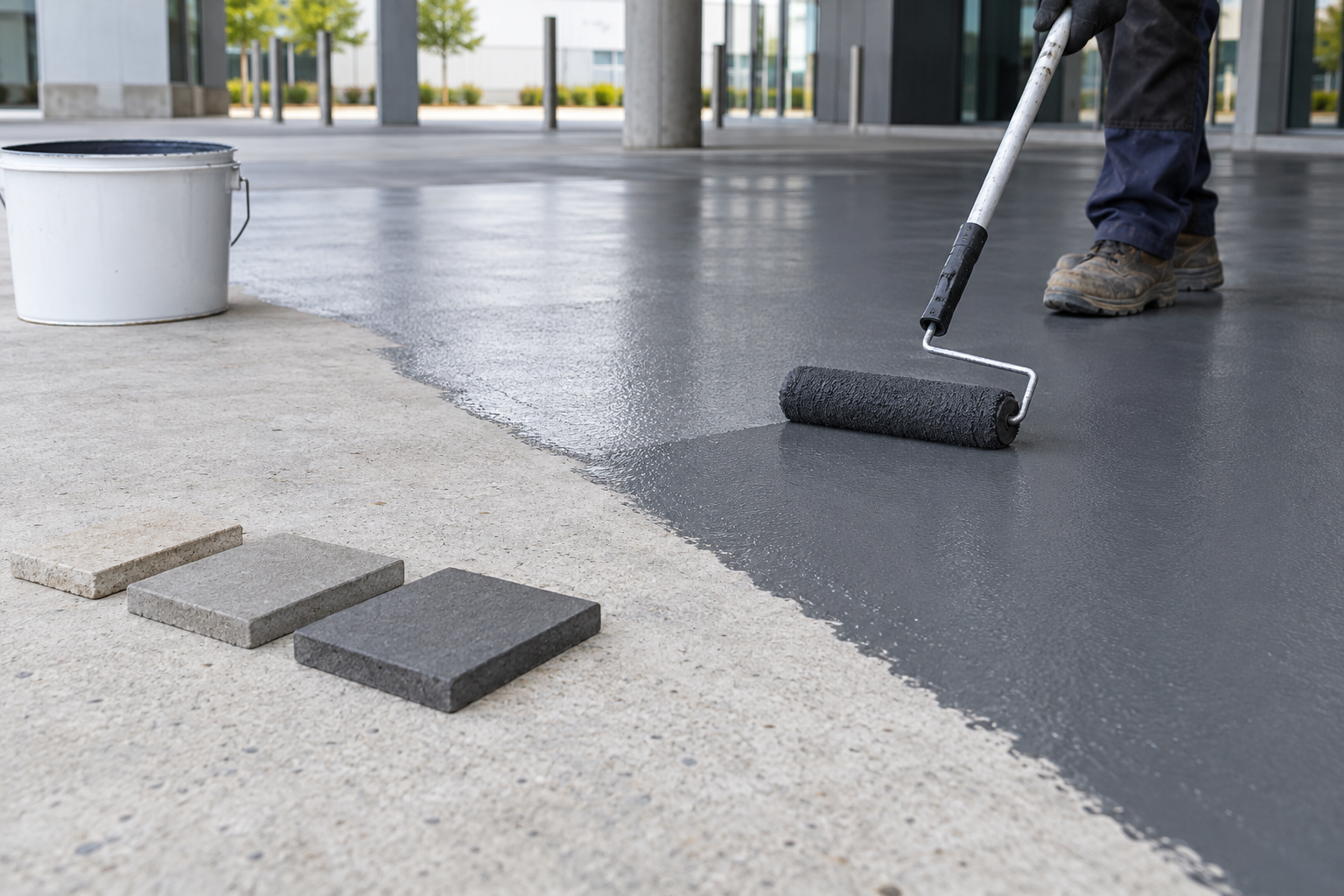
Commercial property owners comparing concrete paint colours face a broader investment decision than choosing a new finish. A faded forecourt, loading entrance or customer parking area may need cleaning, repairs or a different protective system before its appearance can improve. Establishing those requirements early helps distinguish an affordable refresh from work that leaves underlying problems unresolved.
The specification of a concrete sealer can also change the visual outcome. Some products preserve the substrate’s natural appearance, while others form a clear surface coating or introduce colour. These options serve different project objectives, making product selection a practical budgeting decision rather than an interchangeable finishing step.
For businesses managing occupied premises, the resulting costs include preparation, application, restricted access and future upkeep. Evaluating the complete system gives owners a more useful comparison than selecting a contractor on price per square metre alone.
Protection does not always require recolouring
A surface showing wear does not automatically need an opaque finish. Where the existing appearance remains suitable, a penetrating treatment may offer a different approach.
Water-based penetrating products are available that repel water, reduce dirt pickup and resist staining while maintaining the natural appearance of decorative concrete. Clear film-forming products are another category, creating a protective surface coating rather than simply preserving the original look.
The distinction affects how owners define the project. Retaining exposed aggregate or an existing decorative pattern requires a different brief from changing the colour of a plain entrance.
Contractors should explain what the proposed product will do visually and functionally. A sample application can help confirm whether the expected result matches the property owner’s requirements.
New concrete can change the project timetable
A newly poured section may introduce a waiting period that does not apply to neighbouring, established surfaces. Certain manufacturers specify at least 28 days of curing for new concrete before particular penetrating or resin-based products are applied. That requirement is product-specific rather than a universal rule for every treatment.
This matters where a refurbishment includes replacement slabs, new access paths or repaired vehicle areas. Scheduling the finishing contractor immediately after pouring may not suit the selected system.
Property managers should separate the concrete installation schedule from the coating schedule. They also need confirmation of any moisture checks or preparation requirements before application.
Building these stages into the programme reduces the likelihood of rushed decisions when tenants expect an area to reopen.
Exterior exposure requires suitable chemistry
Products used inside a warehouse do not necessarily suit an exposed forecourt. Sunlight, rainfall and changing surface temperatures introduce conditions that should be addressed in the specification.
UV-resistant polyurethane products are available with stated resistance to yellowing, demonstrating why buyers should examine individual performance claims rather than rely on broad product categories.
The relevant authority-link phrase is polyurethane, a material used in various protective coating systems. Its presence in a product name, however, does not establish suitability for every commercial surface.
Businesses assessing driveway coatings should request confirmation that the complete system suits outdoor vehicle access and the existing substrate. The primer, finish and any additional layers need to work together under the manufacturer’s requirements.
Texture introduces a maintenance trade-off
Surface texture deserves attention alongside colour and sheen. A finish selected for pedestrian areas may require different characteristics from one intended primarily for vehicle movement.
Textured systems can also change cleaning requirements. Property managers should ask how the proposed finish will be maintained using the equipment and staffing available onsite.
Entrances exposed to tracked dirt, landscaping debris or regular deliveries need a practical cleaning plan. Selecting an appearance that depends on unusually frequent maintenance can increase operating costs after the refurbishment budget has been spent.
A trial area provides an opportunity to examine the finish under ordinary site conditions. It can also help establish whether the surface is compatible with the property’s intended cleaning procedures.
Preparation should be priced transparently
Existing coatings, contamination and surface damage can alter the work needed before a new system is installed. Quotes that include different assumptions are difficult to compare fairly.
Owners should request separate allowances for cleaning, removal of incompatible materials, repairs and application. Uncertain conditions should be identified clearly, with a process for approving additional work.
This approach improves financial control without requiring the property manager to prescribe technical methods. The contractor remains responsible for explaining preparation appropriate to the specified system.
Records of previous products are valuable here. Where those records are missing, investigation should occur before the final price and programme are accepted.
Lifecycle costs complete the comparison
A commercially useful assessment includes maintenance frequency, repair options and future recoating requirements. The least expensive installation may offer limited value if subsequent work is disruptive or difficult to match.
Handover records should identify products, colours, application dates and care instructions. These details help future contractors assess the surface and give property owners a clearer basis for planning the next maintenance cycle.